The Verdict Up Front
Rouvy vs Zwift has changed quite a bit thanks to the “it depends on your goals” noise flying around. So let me just tell you the answer right now. Zwift wins for most cyclists — structured training, group rides, gamified motivation, the whole package. Rouvy wins for the rider who wants real-world immersion and is actively preparing for an outdoor event. Zwift costs $19.99 per month. Rouvy starts at $10. Everything below is the evidence behind that call.
Ride Feel and Realism — Where They Actually Differ
This is the section most comparison articles fumble completely. I want to be precise here.
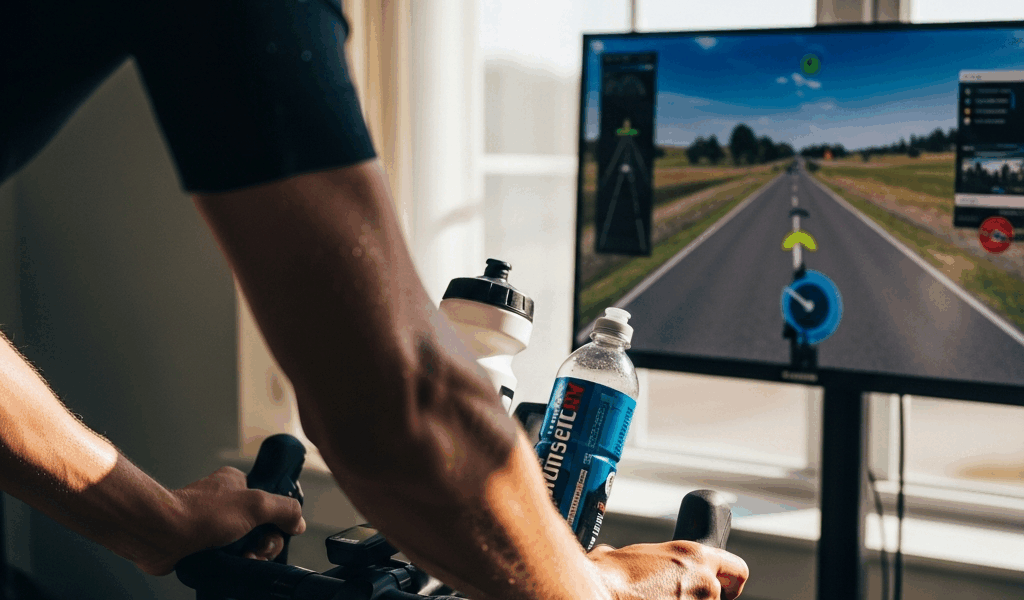
Zwift runs on a purpose-built 3D game engine. Watopia, Richmond, Makuri Islands — none of these places exist. The roads are fictional. The gradients are engineered for training variety. The physics model has been refined over years of competitive use. Rouvy does something fundamentally different: it overlays AR-rendered avatars onto actual video footage of real climbs. Real tarmac on Alpe d’Huez. Real switchbacks on Mont Ventoux. Real gravel on Strade Bianche.
But what is that difference, practically speaking? In essence, it’s the gap between a simulator and a recreation. But it’s much more than that. Rouvy’s grade matching on iconic climbs feels more authentic — when the road ramps to 9% on actual Alpe d’Huez footage, there’s a psychological weight to it that a fictional Zwift climb doesn’t replicate. That said, video quality on Rouvy varies wildly by route. Some are filmed in 4K and look excellent on a large monitor. Others look like they were recorded on a GoPro Hero 5 in 2017 with aggressive compression artifacts.
Zwift’s physics engine is more refined for sprint efforts and group dynamics. Draft modeling in a peloton feels believable. Acceleration out of corners responds in a way that rewards real technique. Rouvy doesn’t have anything close to this — multiplayer interaction is limited, and the sprint physics feel secondary to the whole route-viewing experience.
Here’s what nobody talks about: Rouvy’s real-world video actively changes your pacing behavior. Watching actual footage of a 10km climb makes you go harder earlier than you should. I’ve done this — punched it on the lower slopes of a virtual Ventoux because the visual cues triggered the same competitive response they would outdoors, then blown up at kilometer seven. That psychological pressure directly affects how much you need to eat and drink. A harder-than-planned threshold effort demands more carbohydrate, not less. Rouvy’s realism is a double-edged tool. Spare yourself the wrong turn I took.
Training Structure and Workout Libraries
Quick callout up front — for the majority of cyclists spending winter hours on a trainer, structured training is the whole point.
Zwift’s workout library is large and organized around real progression. The 12-week FTP Builder is genuinely well-designed. Zwift Academy — their annual structured program — has attracted professional input and is free within your subscription. Integration with TrainingPeaks and Garmin Connect means your power data flows cleanly into whatever planning tool you’re already using.
Rouvy has expanded its workout library over the last two years. But structured interval training is clearly not its core product. You’ll find workouts — just no equivalent to Zwift’s program architecture. No long-form plans that move you through base, build, and peak phases with coherent logic.
For cyclists running a periodized nutrition strategy, this matters practically. A Zone 2 endurance session requires roughly 40–60g of carbs per hour depending on duration. Threshold bumps that number up. A long VO2max session can push toward 80–90g per hour. Zwift’s structured workouts let you plan fueling before you clip in — you know exactly what’s coming. Rouvy’s route-based riding means intensity fluctuates with video terrain and your own pacing decisions, which makes pre-session fueling harder to calibrate.
Zwift also has pace partners — robotic riders holding a constant w/kg, available on demand, every single day. There’s no Rouvy equivalent. If you want 90 minutes at 2.0 w/kg building aerobic base without thinking, Zwift’s Coco the Climber is right there waiting. Rouvy simply can’t offer this.
Social Ride Experience and Motivation
Zwift wins this without contest. It’s not close.
The Zwift Racing League runs structured team events on a seasonal calendar. Group rides are listed in advance — typically 50 to 500 riders depending on the event — and start on time like an actual cycling event. The community around Zwift has developed a genuine culture: Discord servers, the Companion app, Strava segments. Getting dropped, fighting back, riding with others at the same wattage — it replicates enough outdoor group riding psychology to keep winter training from becoming entirely mechanical.
Rouvy has multiplayer. Finding a group ride at a specific time with more than a handful of riders is genuinely difficult. It’s not a community platform. It’s a route platform with some social features attached. That’s the honest version.
Frustrated by solo winter sessions that felt pointless and low-effort, I started using Zwift group rides on Tuesday evenings — specifically the Herd rides at around 6:30pm EST — and immediately found myself pushing harder and staying consistent in a way I hadn’t managed alone. Accountability through other people is not a soft benefit. For a lot of cyclists, it’s the difference between January fitness and January couch.
One practical note most indoor training articles skip entirely: a 2-hour Zwift group ride at endurance pace requires the same fueling approach as a 2-hour outdoor ride. That means 60g of carbohydrate per hour minimum — a bottle of mix and something solid at the hour mark. Indoor riding doesn’t reduce the physiological demand. Sweat rate is actually higher indoors without airflow. If you’re riding Zwift group events seriously, don’t under-fuel them just because you’re in your garage.
Which Platform to Choose — The Decision Framework
So, without further ado, let’s dive in on the actual decision.
Choose Zwift if you want structured training plans, race events, or group rides with real people. It’s a more complete training product. The $19.99 monthly cost reflects that.
Choose Rouvy if you’re training for a specific real-world event and want to mentally rehearse the course — or if budget genuinely matters. At $10 per month, that’s a meaningful difference if cost is the constraint.
The one scenario where Rouvy is the clear winner: event-specific course preparation. Training for the Tour de France Femmes parcours, the actual Strade Bianche white roads, or the Mur de Huy before racing them outdoors? Rouvy’s footage-based approach gives you something Zwift simply cannot. Visual familiarity with a real climb — knowing where the gradient eases, where it bites, where the false flat ends — is genuinely useful race preparation. Zwift’s fictional roads offer nothing comparable for this purpose.
While you won’t need a full velodrome setup, you will need a handful of real hardware to make either platform work. Budget a minimum of $500 for an entry-level smart trainer like the Wahoo KICKR Core ($549 at most retailers), and up to $1,200 for something like the Tacx Neo 2T. That hardware cost dwarfs the subscription difference between these two platforms entirely. If you already own a quality smart trainer, the choice comes down to training intent — not price.
I’m apparently a “structure first” rider and Zwift works for me while Rouvy never quite stuck as a daily training tool. That’s what makes the platform choice personal. But the framework doesn’t change: Zwift for training. Rouvy for course prep. Pick the one that matches what you’re actually trying to do this winter.



Subscribe for Updates
Get the latest cycling nutrition hub updates delivered to your inbox.
We respect your privacy. Unsubscribe anytime.