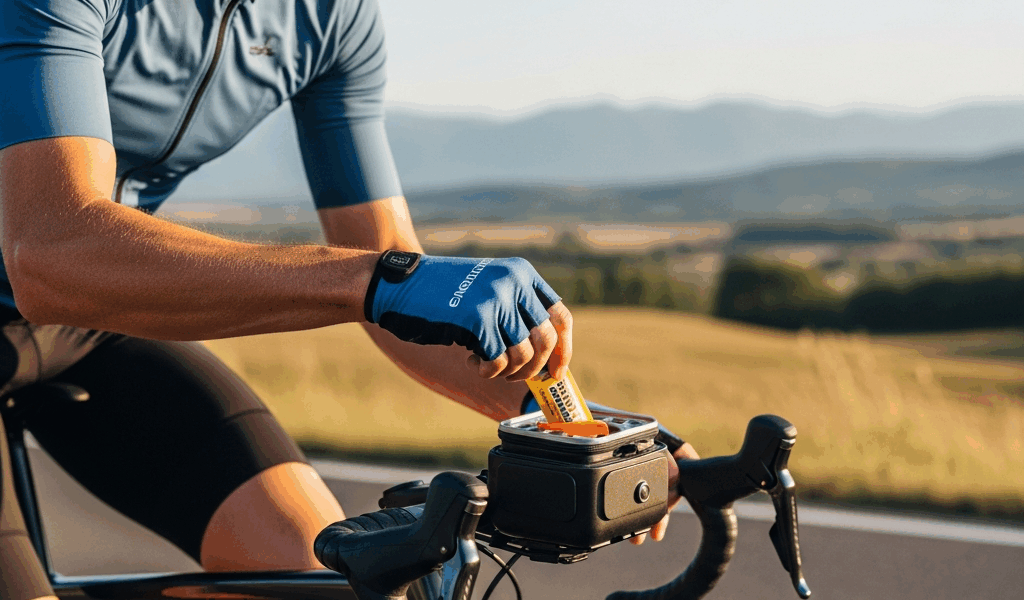
How to Fuel a Century Ride — The 100-Mile Nutrition Plan
What to eat during a 100 mile bike ride is the question that nearly ended my cycling career before it really started. I bonked hard at mile 67 of my first century — legs gone, vision slightly weird, sitting on a guardrail eating a stranger’s spare Clif Bar with zero shame. That experience taught me more about endurance nutrition than any podcast or YouTube video ever has. Since then I’ve ridden fourteen centuries, consulted with a registered sports dietitian, and spent an embarrassing amount of time reading peer-reviewed carbohydrate metabolism research. This plan is what I actually use. No product sponsorships, no brand agenda.
The Numbers — How Many Carbs Per Hour
Start here. Everything else in your century nutrition plan builds on these two numbers: 60 to 90 grams of carbohydrates per hour, and 200 to 300 calories per hour. Write them on your hand if you have to.
The 60g lower end applies to riders using a single carbohydrate source — typically glucose or maltodextrin. The 90g ceiling is only reachable when you’re combining glucose with fructose, because they use different intestinal transport pathways and your gut can actually absorb both simultaneously. Most sports drinks and gels are formulated around a 2:1 glucose-to-fructose ratio for exactly this reason. A product like Maurten Gel 100 delivers 25g of carbs in one small sachet; you’d need roughly three of those per hour at the high end of the range. That gets expensive and repetitive fast.
The calorie target sounds low compared to what you’re burning — a 160-pound rider at moderate century pace burns roughly 500 to 600 calories per hour. You will never fully replace that on the bike. You’re not trying to. You’re trying to spare glycogen and keep blood glucose stable, not achieve caloric neutrality. Accepting that gap is important. Trying to eat 500 calories an hour is a stomach disaster waiting to happen.
One more thing most people get wrong: start fueling at the 30-minute mark, not when you feel hungry. Hunger during exercise is a lagging indicator. By the time your brain signals it, your glycogen is already sliding. Set a timer. Eat before you want to.
Hour-by-Hour Nutrition Plan for 100 Miles
Probably should have opened with this section, honestly — it’s what most people scrolling this page actually need. Here’s how to structure your nutrition across a full century, assuming you’re riding at roughly 15 to 17 mph with a total time of six to seven hours.
Pre-Ride — Three Hours Before the Start
Eat a real meal. I have oatmeal with a sliced banana, a tablespoon of peanut butter, and about 16 ounces of water with a single Nuun Sport tablet dissolved in it. That’s roughly 500 to 600 calories, mostly complex carbs with a small amount of fat and protein to slow digestion. Nothing experimental. Nothing you haven’t eaten before a long ride.
Fueled by a disastrous pre-ride mistake at the 2021 Gravel Grovel in Ohio, where I ate a breakfast burrito ninety minutes before the gun and spent the first two hours of that ride in genuine gastrointestinal misery, I now refuse to eat anything substantial within two hours of a start. Give your body time to actually digest.
Hours One and Two — Light and Consistent
Your glycogen stores are full. You feel good. This is exactly when people make the mistake of eating nothing because they don’t need to yet. Eat anyway. Aim for the lower end of the range — 60g carbs per hour — and keep it simple. One banana, one rice cake, or two Medjool dates every 45 minutes. Sip your first bottle steadily. Don’t race. Don’t get excited. The century is long.
Hours Three and Four — Increase Intake
This is where discipline matters most. Your stores are depleting, your body is working harder psychologically (mile 50 can feel both halfway done and impossibly far from finished), and your digestion is actually more efficient now that you’ve been riding steadily. Push toward the 75 to 90g carb range. Add a gel or two alongside real food. If there’s a SAG stop, use it — refill bottles, grab something salty.
I carry a small insulated jersey pocket pouch from Revelate Designs — the Mountain Feedbag, about $34 — that holds two rice cakes and a gel without turning everything into a warm, compressed mess. Details like this matter at hour four.
Hours Five and Beyond — Whatever Your Stomach Tolerates
Honest answer: this varies enormously by person. Some riders can still eat normally at mile 80. Others need to drop back to liquids only. Know yourself. In my experience, salty and savory foods become far more appealing than sweet ones after five hours of riding. A small peanut butter and honey sandwich on white bread — white, not whole grain, because you want fast digestion — is something I can eat at mile 85 when the thought of another gel makes me want to quit cycling forever.
Keep eating. Fatigue makes this feel optional. It is not.
Real Food vs Gels — What Works at Mile 75
Gels are engineered for convenience, not palatability. They work extremely well for the first two to three hours. After that, many riders — myself included — develop a deep, specific hatred for them. The texture becomes wrong. The sweetness becomes oppressive. You open a Gu Salted Caramel at mile 78 and your body just says no.
This is not weakness. This is normal.
Real food solves the psychological problem. Rice cakes made with soy sauce, sesame oil, and a little salt — a recipe popularized by the Rapha Continental riders and Allen Lim’s cookbook — are genuinely good to eat at mile 70. Banana halves wrapped in aluminum foil. Fig Newton cookies, which deliver about 11g of carbs each and cost about $4 for a pack. Salted boiled baby potatoes in a small zip-lock bag, a trick I borrowed from ultra-cycling lore that sounds insane until hour six when they taste like the best thing you’ve ever eaten.
The practical answer is to use both. Gels and chews for convenience during high-intensity sections where eating a rice cake while descending feels dangerous. Real food at rest moments, aid stations, and any time you’re climbing slowly enough to unwrap something.
A sample split for a seven-hour century: carry four to five gels, two rice cakes, one banana, a small bag of dates or fig bars, and rely on whatever the event provides at aid stations. Don’t gamble entirely on aid stations — some are stocked brilliantly, some have warm water and a single bucket of orange slices.
Hydration Strategy — More Than Just Water
One bottle per hour is the floor, not the goal. In warm weather — anything above 75°F — plan for 1.5 bottles per hour. A standard cycling bottle holds about 21 to 24 ounces depending on the brand; I use the Specialized Purist 22oz bottles because they don’t retain flavor between rides. At 15 mph in July heat, you can sweat through 32 ounces an hour without feeling like it.
Water alone is insufficient for a century. Sweat contains sodium, potassium, magnesium, and chloride. Replace only the water without replacing electrolytes and you dilute your blood sodium, which leads to a condition called hyponatremia — headaches, nausea, confusion, and in severe cases, serious medical problems. Electrolytes in every bottle. Every single bottle.
I use a combination approach: one bottle with Skratch Labs Sport Hydration Mix (80mg sodium per serving, about $22 for a 20-serving bag), one bottle with plain water. The plain water bottle is for rinsing my face and for moments when the flavored drink starts tasting too sweet.
Signs of Dehydration to Watch For
- Dark yellow urine at aid station stops — aim for pale straw color
- Headache appearing in the back of the skull, not the front
- Muscle cramps, particularly in the calves or hamstrings
- Unusual irritability or difficulty making simple decisions
- Reduced sweat rate despite working hard — this one is alarming when it happens
If you hit two or more of those signs simultaneously, stop. Drink. Eat something salty. Wait ten minutes before pushing on. No finish-line time is worth a medical incident on the side of the road.
One underrated hydration move: start your pre-ride hydration the night before. Drink an extra 16 to 20 ounces of water with dinner, and keep a glass on your nightstand. Showing up to the start line already slightly dehydrated — which is easy to do if you’re nervous and forgetting to drink — puts you behind immediately.
A century is a long day on the bike. The riders who finish strong aren’t always the fittest — they’re usually the ones who treated nutrition as seriously as their training. Get the numbers right, start fueling early, mix real food into the rotation, and drink more than feels necessary. That’s the whole plan. The guardrail at mile 67 taught me that the hard way so you don’t have to.



Subscribe for Updates
Get the latest cycling nutrition hub updates delivered to your inbox.
We respect your privacy. Unsubscribe anytime.