Tart Cherry Juice for Cycling Recovery — Does the Science Back It Up?
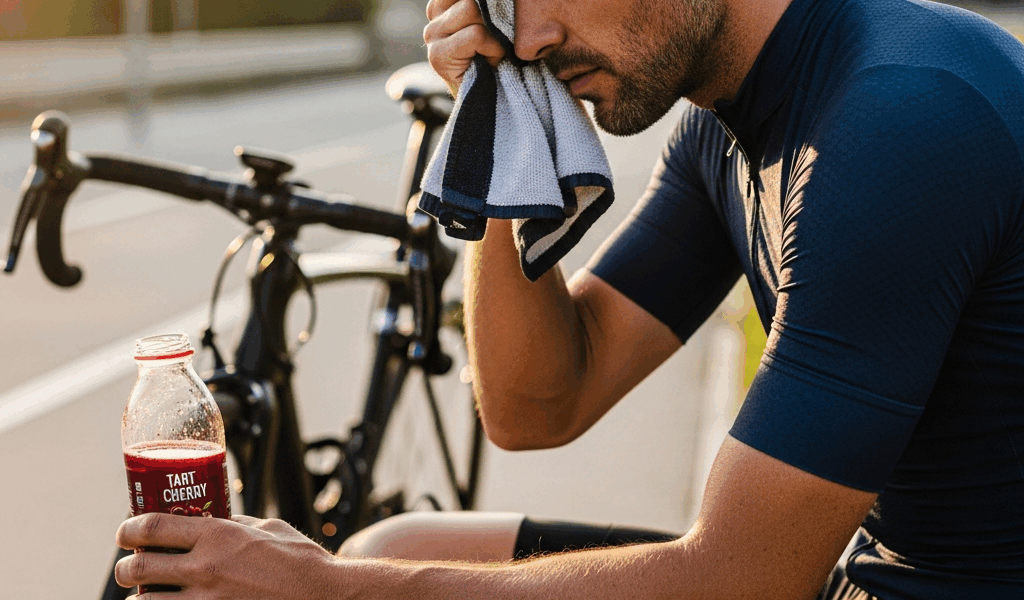
Tart cherry juice for cycling recovery has become tricky with all the supplement noise flying around. For years I lumped it in with the bro-science crowd — you know the type, guys selling magnesium sprays out of a duffel bag at the criterium parking lot. Then came a particularly ugly stretch of back-to-back crits, my legs were absolutely cooked, and a teammate shoved a small bottle of Cheribundi concentrate into my hand at the finish line. I drank it. Mostly out of desperation. The next morning I felt enough better that I actually went hunting for the research.
This article includes affiliate links. We may earn a commission at no extra cost to you.
What I found was more solid than I had any right to expect.
What the Studies Actually Found
The anchor study here — Howatson and colleagues, published in the Scandinavian Journal of Medicine and Science in Sports in 2010 — recruited 20 trained male athletes and ran them through a marathon protocol. Not cycling, fine. But muscle damage from a hard marathon effort maps reasonably well onto what happens during a long road stage or a four-day omnium. The tart cherry juice group came out with significantly lower creatine kinase levels and inflammatory markers. They also recovered isometric strength faster. Small sample. Worth noting. But the effect size was real enough to keep reading.
Bell and colleagues in 2014, writing in the European Journal of Sport Science, looked at actual cyclists — 16 of them, trained, not weekend warriors. They ran a simulated race, then hit sprint tests afterward. The cherry group held better power output and reported lower perceived soreness. Sixteen people is not a landmark trial. But these were competitive cyclists, which makes the findings more relevant to most people clicking on an article like this one.
There’s also a 2006 pilot study by Connolly and colleagues in the British Journal of Sports Medicine — 14 subjects doing eccentric resistance work — that showed meaningfully less strength loss and pain in the cherry juice group. The limitation is obvious: lifting weights isn’t riding a bike. But the mechanism driving these results — anthocyanins reducing oxidative stress at the cellular level — doesn’t care much about which sport you’re doing. Damaged muscle fiber is damaged muscle fiber.
The consistent thread across all three studies is the anthocyanin concentration in Montmorency tart cherries specifically. These are not — I cannot stress this enough — the sweet Bing cherries you eat off the stem in July. Montmorency cherries have meaningfully higher polyphenolic content, and that distinction matters enormously when you’re standing in a grocery aisle trying to figure out what to buy.
How Much to Drink and When
Here’s the part worth saying first. Because dosing is where most cyclists quietly get it wrong, and the protocol is more specific than “drink some cherry juice after your ride.”
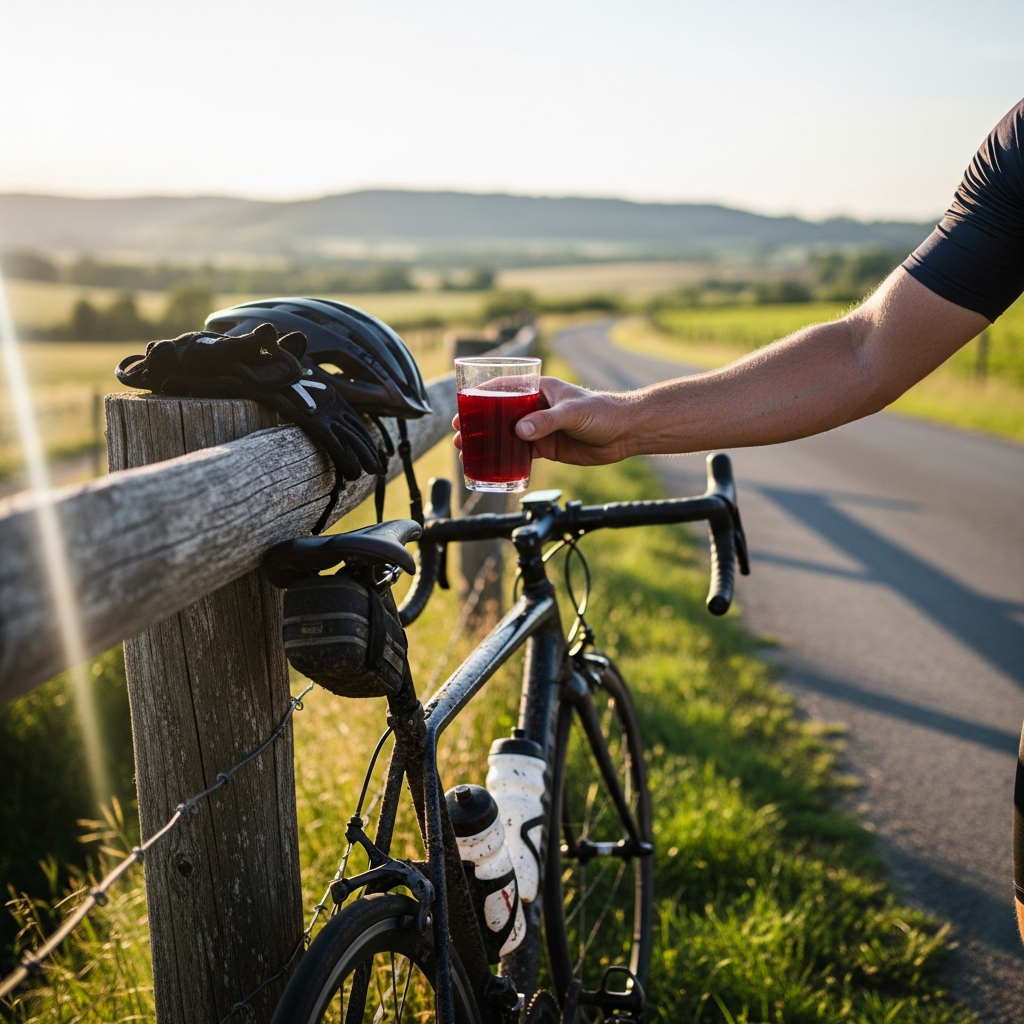
What shows up consistently across the research: 8 to 12 ounces of tart cherry juice twice daily, or the equivalent in concentrate. If you’re using concentrate — and you probably should be, more on that below — that’s roughly 1 ounce diluted in water, twice a day. One ounce of good concentrate equals somewhere around 60 to 80 whole tart cherries. You’re getting a meaningful dose of those active compounds. Not trace amounts. Not homeopathy.
Timing Around Hard Efforts
Start four to five days before your target event. Race day minus four is your anchor date. Keep going through the event itself and for two days after. This loading window matters — the anthocyanins need time to accumulate and actually do something useful at the cellular level. The studies showing the strongest effects used multi-day protocols, not single pre-race doses. Avoid the path I took — I treated it like a recovery drink and skipped the morning serving for weeks, essentially following half a protocol and wondering why results felt inconsistent.
For regular training blocks without a specific race target, twice daily is still the standard. Morning with breakfast, evening after your ride.
Calories and Sugar — A Real Consideration
A 12-ounce glass of tart cherry juice runs 160 to 180 calories and 30-plus grams of sugar. For cyclists managing weight through a competitive season, that math adds up fast. Concentrate largely solves this — a 1-ounce serving sits around 70 calories and delivers the same anthocyanin load. If you’re in a weight-conscious training block, concentrate is almost certainly the smarter format.
Tart Cherry vs Other Recovery Supplements
Most cyclists are already running some version of a recovery stack. Protein shake after rides. Maybe electrolytes, maybe BCAAs, maybe a turmeric capsule someone on the team swears by. Where does cherry juice actually fit into that?
Protein — whey or a solid plant blend, 20 to 40 grams post-ride — handles muscle protein synthesis. Cherry juice doesn’t touch that. These two things aren’t competing — they’re doing entirely different jobs. Take both.
BCAAs are genuinely contested territory right now. The recovery benefit for athletes already eating adequate protein is marginal at best — arguably non-existent. Cherry juice has better study support for recovery-specific outcomes than BCAAs do for most cyclists eating real food.
Turmeric and curcumin are the closest competition. The anti-inflammatory mechanism is similar in theory. But what is curcumin, really? In essence, it’s a polyphenol — but it’s much more complicated than that. The problem is bioavailability. Without fat or piperine, your body absorbs almost none of it. Products that actually solve this — Theracurmin, Meriva formulations — cost significantly more per serving than cherry juice does. For the money, cherry juice wins on both evidence quality and cost-per-serving.
Magnesium glycinate for sleep and cramping is complementary, not competing. Omega-3s for chronic inflammation are a longer-game supplement that stacks fine alongside cherry juice. Think of tart cherry as your acute recovery tool — the thing you reach for during hard training blocks and target event windows, not necessarily a 365-day commitment.
Practical Buying Guide
Frustrated by bottles labeled “cherry juice” that turned out to be mostly apple juice with a cherry on the label — literally — I started reading ingredient lists more carefully. The key phrase to hunt for: Montmorency tart cherry. Not “cherry juice blend.” Not “dark cherry.” Not “mixed berry.” Montmorency. That’s the specific cultivar with the anthocyanin concentration the studies are actually based on.
Concentrate vs Juice — Which to Buy
Concentrate might be the best option for most cyclists, as cycling recovery requires consistent daily dosing over multiple days — and concentrate is far easier to travel with than a 32-ounce juice bottle stuffed into a race-weekend bag. Standard concentrate bottles last several weeks at the study-level dose.
Cheribundi Tart Cherry Juice Concentrate is probably the most widely available option in the US right now. Whole Foods carries it reliably; Costco gets it seasonally. A 32-ounce bottle runs $18 to $22 depending on retailer — roughly $1.10 to $1.40 per serving. That’s less than a single serving of most protein powders.
Lakewood Organic Pure Tart Cherry Juice is a whole-juice option at around $9 to $12 for 32 ounces. The calorie load is higher if you’re doing 8 to 12 ounces twice daily, but apparently the taste is significantly better for people who find concentrate too sharp even when diluted.
FruitFast Montmorency Tart Cherry Concentrate — sometimes labeled Dynamic Health, same product — comes in 16-ounce and 32-ounce bottles and is consistently available on Amazon. Price is comparable to Cheribundi, availability is slightly spottier depending on when you’re ordering.
What to Avoid
Generic store-brand “cherry juice” is usually a blended product — minimal Montmorency content, padded with apple or grape juice. Check the ingredient list. If it says “cherry juice from concentrate” without specifying Montmorency, or if other juices appear ahead of cherry in the ingredients, put it back. You won’t hit the study-level anthocyanin dose from a blended product. You’ll just be drinking juice.
Capsule supplements exist and some people prefer them — the evidence base is thinner for capsule forms versus juice or concentrate, and you lose any hydration benefit that’s genuinely useful during heavy training weeks. I haven’t seen a compelling reason to choose capsules over concentrate for most cyclists. First, you should try concentrate at the full dose — at least if you want results that actually resemble what the studies found.
This new category of food-based recovery supplements took off several years ago and has eventually evolved into the crowded, confusing market that cyclists know and navigate today. The bottom line on tart cherry specifically: the studies are small, they’re not all in cyclists, and nothing here replaces sleep, smart training load management, or eating enough. But for around $1.25 a day around your hard blocks and target events, the evidence is good enough that I’m not lining up without it.


Subscribe for Updates
Get the latest cycling nutrition hub updates delivered to your inbox.
We respect your privacy. Unsubscribe anytime.