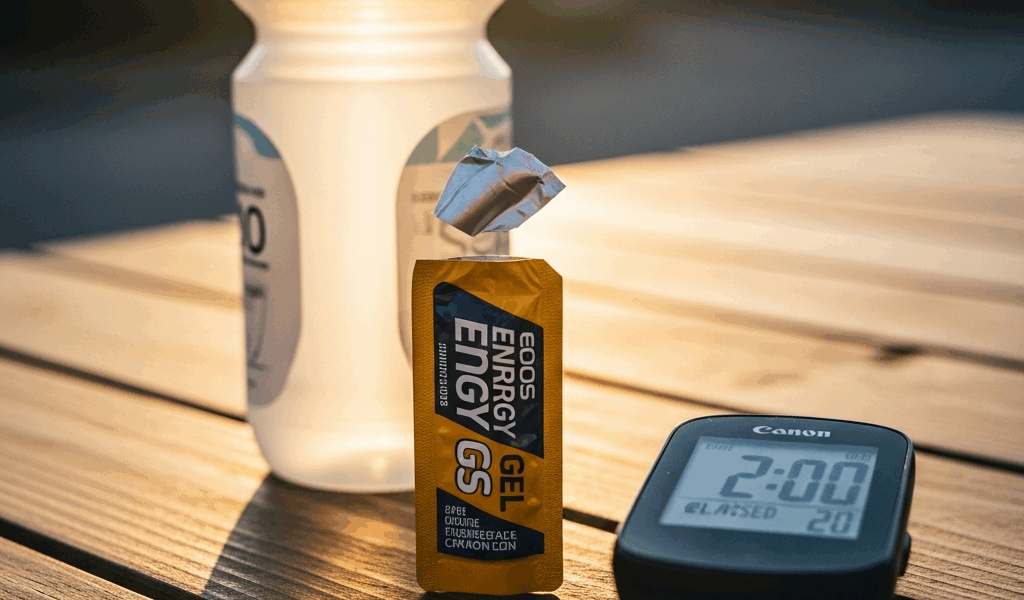
The Two-Hour Energy Wall — And Why It Happens
I bonked spectacularly on a 110-mile ride last summer. Two hours and fifteen minutes in, somewhere around mile 52, my legs felt like they’d been filled with wet concrete. The power just evaporated. I went from holding 195 watts to barely managing 140. My vision got fuzzy. I had to stop at a gas station.
What I figured out that day — the hard way — is that the two-hour energy crash isn’t random. It happens with almost mechanical precision. It’s also completely preventable if you understand what’s actually happening in your body.
Here’s the thing about cycling energy crashes two hours into rides: your muscles are running out of stored glycogen at almost exactly the moment your pre-ride meal has been digested and absorbed. That’s not coincidence. That’s your physiology working against you.
When you ride, your legs burn through glycogen — the carbohydrate stored in your muscles and liver. Most cyclists start out with full glycogen tanks. You can sustain moderate to hard effort for roughly 90 to 120 minutes before those tanks empty. Around the 100-minute mark, if you haven’t consumed calories since before you got on the bike, your body starts sending distress signals. Your legs get heavy. Mental fog rolls in. You lose your ability to maintain power. Cyclists call this “bonking” or “hitting the wall.”
The sensation isn’t subtle. It feels different from regular tiredness — it’s sudden, almost mechanical. One moment you’re riding fine. The next moment, your watts plummet and won’t come back up. You feel dizzy. Your stomach might feel hollow even though you ate before the ride.
That timing — the two-hour wall — is telling you something specific. It’s not motivation or fitness. It’s fuel timing.
The Fueling Gap Most Cyclists Miss
Probably should have opened with this section, honestly.
I see the mistake constantly: cyclists fuel themselves before the ride, then assume that meal will carry them through. They eat a bagel and peanut butter two hours before departure. They roll out thinking they’re set. Then 90 minutes into the ride, their energy drops like a stone.
The gap between pre-ride fueling and on-bike energy availability is where most cyclists bonk. That’s the real problem.
Here’s what actually happens: that pre-ride meal takes time to digest and enter your bloodstream. A bagel and peanut butter? You’re looking at 2 to 3 hours for complete digestion and absorption. Eat at 6 a.m. for a 7 a.m. ride start, and you’re eating at the beginning of that digestion window, not the end. The carbs are still working their way through your system when you hit hour two of the ride.
Meanwhile, your on-bike glycogen tank depletes on a hard schedule. At threshold effort — around 85% of max heart rate — you burn roughly 60 grams of carbs per hour. At endurance pace, 65-75% of max heart rate, you’re still burning 40-50 grams per hour. With roughly 300-400 grams of total stored glycogen available, simple math tells you that you have a 6-8 hour window at endurance pace, or 5-7 hours at threshold. But that assumes no fueling during the ride. It doesn’t. Most cyclists ride hard enough that their window is closer to 90-120 minutes without mid-ride refueling.
The fix is what I call a “refueling window” — when you need to start consuming calories during the ride, not before it. For rides longer than 90 minutes, you should be taking fuel on the bike starting around the 30-45 minute mark. Not at the start. At the 30-45 minute mark.
This feels counterintuitive to most riders. They think: “I’m not tired yet. Why would I fuel?” But that’s the trap. You fuel before you feel depleted, not after.
Carb Timing During the Ride — The Real Fix
Once I diagnosed that premature two-hour crash, I restructured my fueling protocol. Three variables: start timing, carb dosage, and fuel format. The results were immediate.
For any ride over 90 minutes, here’s what I do:
First fuel window: 30-45 minutes into the ride. This is where you take your first source of carbs. On a 110-minute ride, that’s roughly mile 12-15 depending on your pace. Take 15-30 grams of carbs — a single energy gel like Gu (around $1.25-$1.50 per packet) or half an energy bar. Chase it with 8 ounces of water.
Secondary fuel windows: every 45 minutes after that. Once you’ve taken the first fuel, you’re on a 45-minute refuel schedule. So at roughly 75-80 minutes, another 15-30 grams of carbs. Then again around 120 minutes if the ride extends that long. This timing prevents the moment where your blood glucose drops below the threshold where your muscles can access it efficiently.
Total carb target: 30-60 grams per hour of riding. The exact number depends on intensity. Hard efforts — threshold pace or faster — demand 50-60 grams per hour. Endurance pace rides can function on 30-40 grams per hour.
Intensity matters quite a bit here: a threshold ride, where you’re pushing hard and your heart rate sits around 160-170 bpm, needs earlier fueling and more frequent dosing. You’re burning glycogen faster. A threshold ride gets first fuel at 30 minutes, not 45. An endurance-pace ride can stretch that first fuel window to 45 minutes.
Format matters too, but less than people think. I’ve used gels, sports drinks, and energy bars interchangeably — gels are convenient (no unwrapping while riding), sports drinks let you fuel while hydrating simultaneously, energy bars work but are harder to consume at speed. Pick whatever your stomach tolerates. I bonked once partly because I tried a new gel flavor that made me nauseous.
The key is consistency and adherence. Set a timer on your watch if you have to. It sounds mechanical, but that’s the point — you’re not fueling based on feeling hungry. You’re fueling based on glycogen burn rate.
Electrolytes and Hydration That Keeps Energy Stable
Water alone isn’t enough.
I learned this the expensive way on a hot August ride. I fueled perfectly with carbs — gel at 40 minutes, another at 85 minutes. But I only drank water, no electrolytes. My energy still crashed around 100 minutes, and I felt dizzy on top of it.
Here’s why: dehydration accelerates the energy crash. When you’re dehydrated, your blood volume drops slightly. That makes it harder for your cardiovascular system to deliver carbs and oxygen to your muscles simultaneously. Dehydration also slows gastric emptying — the process where food leaves your stomach and enters your bloodstream. Inadequate hydration actually prevents your fuel from being absorbed efficiently.
Add electrolytes — specifically sodium — and that absorption speeds up. Sodium also triggers thirst, making you drink more, and helps your body retain the fluid you’re consuming.
For rides over 90 minutes, you want roughly 300-500 mg of sodium per hour. A sports drink like Gatorade runs roughly 110 mg sodium per 8 oz serving. An electrolyte tablet like Nuun added to water — roughly 360 mg sodium per tablet — hits the range more precisely. I use a combination: a sports drink at the first fuel window, water with an electrolyte tablet at the second.
Hydration target: aim for 500-750 ml (17-25 oz) of fluid per hour, depending on temperature and sweat rate. Cool day? 500 ml per hour is sufficient. Hot day? Push toward 750 ml per hour.
The interaction between fuel, hydration, and electrolytes is the reason your two-hour crash happens faster in summer than spring. Heat increases sweat rate, which depletes electrolytes faster, which slows carb absorption, which accelerates glycogen depletion.
Quick Troubleshooting Checklist
Use these questions to diagnose your specific fueling failure:
- Did you eat 3+ hours before the ride? If yes, that pre-ride meal is already largely digested and won’t help at hour two. If no, move to the next question.
- Are you fueling during the ride at all? If the answer is no, that’s your problem. Start taking gels or sports drink at the 40-minute mark for any ride over 90 minutes.
- Are you fueling every 45 minutes after the first consumption? If you took fuel once at 40 minutes, then skipped the next window at 85 minutes, you’ve re-opened the glycogen gap.
- Is your stomach the limiting factor, or actual fuel depletion? Try this on your next bonk-prone ride: consume carbs starting at 30 minutes, before you feel depleted. If the crash disappears, your problem is fueling timing. If it persists, your problem might be GI tolerance or intensity pacing.
- Are you consuming electrolytes with your carbs, or water only? Switch to a sports drink or electrolyte tablet and see if absorption improves.
- How much total carbs are you consuming per hour? Track it. If you’re averaging 20-25 grams per hour, increase to 40-50 grams per hour and reassess.
The two-hour crash is solvable. It’s not a fitness problem — it’s a fueling logistics problem. Fix the timing, and the wall disappears.




Subscribe for Updates
Get the latest cycling nutrition hub updates delivered to your inbox.
We respect your privacy. Unsubscribe anytime.