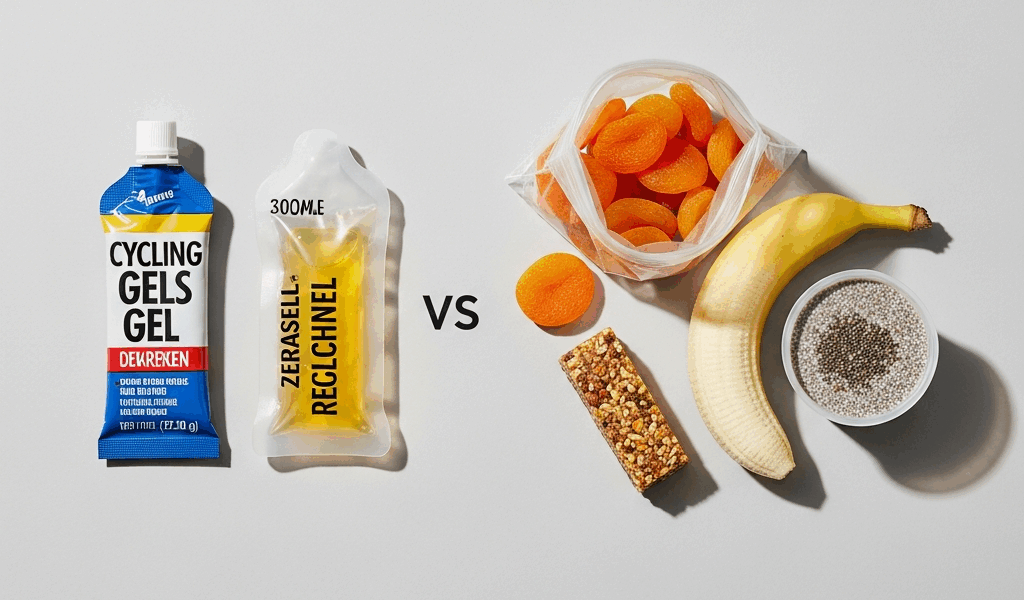
Cycling Gels vs Real Food — Which Is Actually Better for Performance?
The gels vs real food debate has changed quite a bit thanks to the marketing noise flying around. As someone who has ridden both sides of this argument across hundreds of hours in the saddle, I taught myself the working side of on-bike nutrition the hard way. Early days, I was fully committed to engineered nutrition — pockets stuffed with SiS Beta Fuel and Maurten 100s, convinced that anything less was amateur. Then, somewhere around the 140km mark of a 200km audax, a guy in his sixties handed me a homemade rice cake. I nearly wept. That single rice cake — slightly squashed, wrapped in foil, smelling faintly of coconut — outperformed every gel I’d eaten that day. Or at least it felt that way. The honest answer to which approach wins is less satisfying than either camp wants to hear.
This article includes affiliate links. We may earn a commission at no extra cost to you.
What Gels Actually Are — and Aren’t
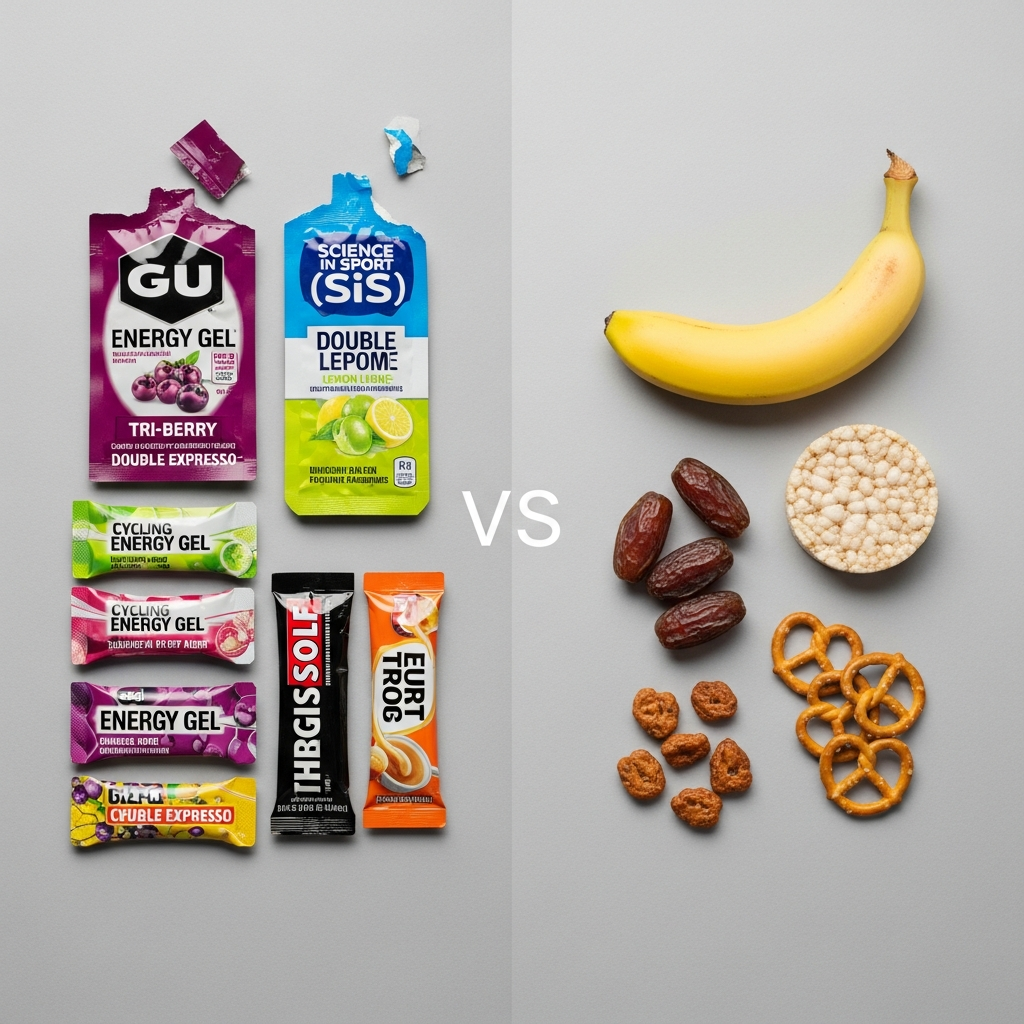
But what is a sports gel? In essence, it’s concentrated carbohydrates in a semi-liquid suspension. But it’s much more than that — or at least the branding wants you to think so. Strip back the packaging on a GU Energy Gel or a High5 IsoGel and what you’re mostly looking at is maltodextrin, a long-chain glucose polymer, combined with fructose in varying ratios. Some gels use a 2:1 maltodextrin-to-fructose ratio, which Maurten and SiS market heavily. Others lean almost entirely on maltodextrin.
The 2:1 ratio actually matters. The gut uses two separate intestinal transporters to absorb glucose and fructose — SGLT1 handles glucose, GLUT5 handles fructose. Running both simultaneously raises the total carbohydrate absorption ceiling. Research puts this around 60g per hour for glucose alone, climbing to roughly 90g per hour when fructose is added. That’s the actual science behind the premium pricing. Not magic. Parallel plumbing.
Beyond carbohydrates, gels typically carry a small amount of sodium — usually 50–100mg per sachet — for electrolyte balance and, in some formulations, absorption support. Some include caffeine. Gu Roctane has 35mg per gel; their Espresso Love runs 40mg. A few throw in amino acids. These additions are mostly marginal at the doses included. What gels aren’t: a superior food source, a replacement for training adaptation, or necessary for rides under two hours for most riders. The marketing suggests otherwise. The physiology doesn’t support it.
Absorption Speed — Gels vs Banana vs Rice Cakes
Worth mentioning before anything else. Absorption rate is the actual hinge point of this whole debate — not cost, not taste. How fast carbohydrates reach working muscle is what separates a gel from a banana during a criterium versus a long Sunday ride.
Glycemic index gives a rough map here. Pure maltodextrin sits around 85–105 GI depending on chain length — essentially equivalent to glucose. A ripe banana lands somewhere between 51–62. White rice comes in around 72. A homemade oat-and-honey bar hovers around 55–65. Lower GI means slower glucose release into the bloodstream — straightforward enough.
Food form changes things further. Liquids and gels bypass much of the mechanical digestion that solid food demands. Chewing, salivary amylase, gastric breakdown — gels skip most of this queue. From consumption to bloodstream, a gel can deliver usable glucose in roughly 15–20 minutes under exercise conditions. A banana takes longer, partly because of its physical structure, partly because fructose metabolism routes differently through the liver before reaching circulation as glucose.
Rice cakes sit interestingly in the middle. The compressed white rice and salt blocks made famous by the Rapha crowd and Allen Lim’s cookbook are genuinely easy to digest — low in fat and fiber, which slow gastric emptying — and deliver carbs at a moderate rate. Homemade versions using sushi rice, a pinch of salt, and a little coconut oil pack roughly 30–35g of carbs per 60g portion. Easy to make the night before. Genuinely palatable at hour four when everything sweet starts tasting like regret.
Speed of absorption matters most when intensity climbs. VO2max efforts, criterium racing, hard climbing — you want carbohydrates available fast. At endurance pace, that urgency largely disappears. A banana eaten 20 minutes before a climb does the same job as a gel eaten 10 minutes before it. That’s what makes real food endearing to us long-ride cyclists — it works when the clock isn’t pressing.
Stomach Tolerance on Hard Efforts
Here’s where real food starts losing ground for some riders. Side-step the error I made — I ate two mini croissants from a mountain sportive feed zone while riding at high effort and spent the following 30 minutes deeply regretting that decision. Gut tolerance at intensity is not something to experiment with on race day.
During hard exercise, blood gets redistributed away from the digestive system toward working muscle. Gastric emptying slows. Splanchnic blood flow drops by 60–70% at near-maximal intensities. Solid food sitting in your stomach during a hard effort doesn’t process efficiently — it sits, it sloshes, and for riders sensitive to GI distress, it triggers nausea, cramping, or worse.
Gels win here. Their liquid consistency means faster entry into the small intestine compared to solids. Lower fiber and fat content means less to process. Most isotonic gels — SiS Go Isotonic, for example — are formulated to be taken without additional water, reducing the osmotic load on the stomach. This matters more than most riders realize. Hypertonic gels taken without water actually pull fluid into the gut, which causes cramping. One of the most common gel mistakes people make. I made it multiple times before someone explained the osmolality issue in a parking lot after a sportive.
The crossover point lands roughly around 75–80% of FTP. Below that threshold, a well-chosen real food option — rice cake, banana, a Nakd bar, even a Jaffa Cake — causes minimal GI distress for most riders. Above it, especially sustained efforts over 20 minutes, gels present a lower-risk option. Not zero risk — some riders have GI issues with gels too, particularly high-fructose formulations — but lower risk.
Long-distance endurance riding creates a different problem entirely. Extended time at moderate intensity — a 300km randonneur brevet, a full-day gran fondo — actually increases appetite for real food. Your brain rebels against sweet gel flavor somewhere after hour five. Palate fatigue is real, and it causes riders to under-fuel badly. Mixed feeding strategies solve this practically: real food in the first half, gels for intensity spikes or late-ride fueling when solid food becomes unappealing.
Cost Per Gram of Carbs
This is where real food wins. And it’s not particularly close.
| Fuel Source | Approx Cost | Carbs per Serving | Cost per 30g Carbs |
|---|---|---|---|
| SiS Go Isotonic Gel | £1.40 per 60g sachet | 22g carbs | ~£1.90 |
| Maurten Gel 100 | £3.20 per sachet | 25g carbs | ~£3.84 |
| Gu Energy Gel | £1.60 per 32g sachet | 21g carbs | ~£2.29 |
| Ripe Banana (medium) | ~£0.20 each | 23–27g carbs | ~£0.23 |
| White Rice Cake (homemade) | ~£0.15 per piece | 30–35g carbs | ~£0.14 |
| Medjool Date (two dates) | ~£0.40 | ~36g carbs | ~£0.33 |
The homemade rice cake is the clear winner on cost — by a distance. Sushi rice from a 1kg supermarket bag runs roughly £1.50–2.00. Add a pinch of salt, a tablespoon of coconut oil, press into a baking tray, refrigerate overnight, cut into portions the next morning. You’re paying around 14–15 pence per 30g carbs delivered. A Maurten gel delivers the same carbohydrates for nearly 27 times that cost. Twenty-seven times.
For the average club rider doing 10 hours of training per week and targeting 60g carbs per hour, the annual cost difference is genuinely significant. Running gels exclusively could cost £300–400 on fueling alone. A mixed real food strategy with occasional gel use for races or hard sessions might run £60–80. The counterargument is convenience — gels don’t require preparation, don’t spoil, and fit in a jersey pocket without creating a sticky situation three hours in. Both true. But convenience carries a steep price at £3.84 per 30g carbs.
The Verdict by Ride Type
There isn’t one universal answer — stating definitively that gels are better or real food is better requires ignoring duration, intensity, individual gut tolerance, and budget. Here’s the honest breakdown.
Rides Under 90 Minutes
You don’t need either, physiologically speaking. Glycogen stores from a normal pre-ride meal cover this duration for most efforts. Riding hard intervals under 90 minutes? A banana before you leave and water on the bike is sufficient. Spending money on gels for a sub-90-minute ride is mostly unnecessary — the physiology simply doesn’t demand it.
Rides of 2–3 Hours at Moderate Intensity
Real food wins here. Bananas, rice cakes, a couple of Medjool dates, a homemade flapjack. Your gut is working fine at this intensity, palatability matters more than absorption speed, and real food is cheaper and creates less packaging waste. Save the gels for genuine emergencies if you bonk unexpectedly — which, at this intensity, you probably won’t.
Races or High-Intensity Rides Over 2 Hours
Gels earn their place here. Hard efforts, repeated surges, criterium racing, competitive sportives with sustained high-intensity sections — these are the conditions gels were actually designed for. Stomach tolerance is compromised. Fast absorption matters. The convenience of a tear-and-consume sachet beats fumbling with a rice cake at 400 watts. Use them without guilt.
Long Endurance Rides Over 4 Hours
Mixed strategy is the answer. Real food for the first two-thirds, particularly if intensity stays below threshold. Gels or high-carb liquid mixes for the final portion — when solid food becomes unappealing and fatigue accumulates. Adding caffeine gels might be the best option in the final 60–90 minutes, as late-ride performance requires a meaningful stimulus. That is because 40mg of caffeine has solid evidence behind it for sustained output when glycogen is running low.
Frustrated by how much I was spending on Maurten products last season, I shifted to homemade rice cakes for all training rides using a simple Tuesday-night prep routine — sushi rice, salt, coconut oil, foil-wrapped portions in a zipper bag — and reserved gels exclusively for races. Performance didn’t drop. Gut issues didn’t increase. The grocery bill decreased noticeably. That’s the real-world result after roughly eight months and somewhere north of 15,000km on this protocol.
This new approach took off for me several years into my riding and eventually evolved into the mixed-fueling strategy endurance cyclists know and swear by today. Gels are a useful tool. They’re not a superior technology that replaces food. A banana and a rice cake, chosen thoughtfully for the right ride, perform as well as a £3 gel for the majority of hours most cyclists spend on a bike.
The gel brands benefit from conflating elite racing conditions with your Tuesday evening group ride. Keep those contexts separate — and keep more money for the things that actually improve performance, like more time on the bike.

Subscribe for Updates
Get the latest cycling nutrition hub updates delivered to your inbox.
We respect your privacy. Unsubscribe anytime.