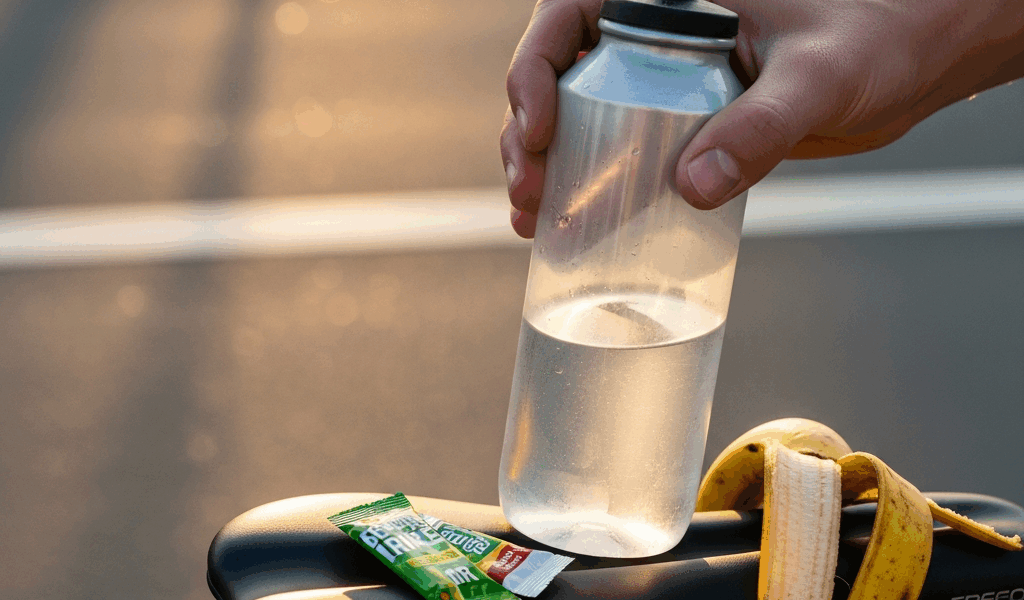
What Late-Ride Weakness Actually Feels Like
Late-ride weakness has shifted noticeably with all the conflicting nutrition advice flying around. Everyone’s talking about bonking, cramping, electrolytes — but nobody’s describing the specific thing that happens in the final miles of a ride. That hollow, creeping feeling. The one where your legs aren’t destroyed, just completely empty.
As someone who has ridden into that wall more times than I care to count, I spent months getting comfortable with what causes it and how to stop it. Today, I will share it all with you.
So, without further ado, let’s dive in.
You know the moment it hits. Not the sharp quad cramp. Not the dizzy spin when you stand too fast off the saddle. This is different — a creeping hollowness in your legs, a sensation that the power you had at mile 40 simply isn’t there at mile 58. Your cadence drops without you deciding it should. Breathing stays controlled. But your mind goes foggy. You start calculating how many minutes until you’re home instead of watching the road.
I hit this wall hard on a 3-hour gravel ride last October. Had to walk the final descent. Not because my legs were destroyed — they weren’t destroyed, just depleted. Everything took more effort for half the output. Pushing through wet concrete, basically. And the worst part wasn’t even the physical sensation. It was the mental fog — irritable, exhausted, unable to make simple decisions. Should I take the shortcut? Is the next climb steep? I genuinely couldn’t decide. That scared me more than the weakness itself.
This is the piece to know up front.
This specific symptom — fading power in the final 10 to 20 percent of a ride, paired with mental dullness — is not cramping. It’s not a full bonk. It’s a measurable decline in force production, the kind that shows up on a power meter as a 15 to 25 percent drop from your mid-ride average. And it has three distinct causes. Each one has a different fix.
Cause 1 — Your Glycogen Ran Out Earlier Than You Think
Most riders blame glycogen depletion for late-ride weakness. They’re usually right — but not for the reason they think. You don’t run out of glycogen at mile 55. You run out much earlier. The weakness just becomes noticeable later.
But what is glycogen depletion, exactly? In essence, it’s your muscles exhausting their local fuel supply. But it’s much more than that — it’s a cascade that starts earlier than you realize and hits harder than you expect.
Your muscles store glycogen in finite pockets. A 150-pound rider at moderate effort burns roughly 400 to 500 calories per hour. Stored muscle glycogen — the fuel your legs actually use — sits at around 300 to 400 grams total. At moderate intensity, that’s gone in 90 minutes without carbohydrate intake. By the time you hit mile 20, if you rode hard at all, the clock is already running.
Here’s what makes this tricky. You probably ate breakfast. Oatmeal, toast, a bagel — something reasonable. Your liver still has glycogen. Your brain is fine. So you feel okay at mile 45. Then, somewhere around mile 75, the muscle glycogen tank actually empties. Your legs have nothing left to pull from locally. They start demanding fuel from your bloodstream instead, which is slower. Your power output collapses.
That’s what makes glycogen depletion so frustrating to us endurance riders — it feels sudden even though it’s been building for hours.
The fix: start fueling at the 30-minute mark, not when you feel weak. Aim for 30 to 60 grams of carbohydrate per hour. On a two-hour ride, that means one gel at 30 minutes and another at 90 minutes — or a sports drink sipped consistently throughout. A single banana is roughly 27 grams. A standard energy gel runs 20 to 40 grams. A bottle of 6-percent sports drink gives you about 36 grams per 16 ounces.
Start early, before you need it. Your digestive system has a processing limit. Wait until mile 50 to start eating on a 90-minute ride and your stomach is already working hard — the carbs arrive too late to prevent the crash. Skip the misstep I made.
Cause 2 — Blood Sugar Is Crashing, Not Just Glycogen
Glycogen depletion and blood sugar crash are not the same thing. This distinction is probably the most misunderstood part of ride nutrition — and honestly, even experienced riders get it wrong.
Blood sugar drops faster than muscle glycogen depletes. Eat a high-glycemic-index food — white bread, a sports drink, a gel — too early in a ride, and your blood sugar spikes hard. Your pancreas releases insulin. Then your blood sugar crashes. Meanwhile, your glycogen stores are still relatively full. This is less common on shorter rides, but it happens on long efforts or when a rider fuels aggressively with simple sugars right from the gun.
More commonly, blood sugar crashes because you didn’t eat anything at all. Or you ate only complex carbs that digest slowly. A 90-minute ride on just breakfast leaves your blood glucose vulnerable to a drop in the final 20 minutes — exactly when you need it most.
The symptoms are more mental than muscular. Fuzzy thinking. Irritability. An inability to push hard even though your legs don’t feel distinctly tired. You want to sprint to the finish but your brain won’t cooperate. Slow decisions about gear choice, line selection, basic navigation. This fog is your central nervous system flagging a glucose shortage — it’s not weakness, it’s a warning.
The fix is fast-acting carbs in the final 45 minutes of any ride longer than 75 minutes. Not the complex carbs from earlier. Simple carbs, right now. A gel. A few chews. Half a banana. Something that enters your bloodstream quickly and brings blood glucose back up. I’m apparently the type who forgets gels exist until it’s too late, and my Clif Shot Bloks sat in my jersey pocket the entire October ride untouched. That was embarrassing. Steer clear of where I went wrong.
Cause 3 — Dehydration Is Reducing Muscle Output
Frustrated by a two-hour ride that felt harder than it had any right to, I started tracking my hydration obsessively for three months straight. Weighed myself before and after every single ride. Measured my bottles. Kept a notes app log. What I found was embarrassing: I was routinely arriving home 2 to 3 percent lighter than I left. Every time.
Even mild dehydration — 2 percent of your body weight — measurably reduces power output. Not just your perception of effort. Actual, measurable power. A 160-pound rider losing 3.2 pounds of fluid sees real declines in force production, especially in the final portion of a ride when fatigue is already stacking up. Blood plasma volume drops. Your heart works harder to deliver oxygen. Muscle temperature climbs. The work feels exponentially harder for the same output.
I’m apparently a heavy sweater and my Specialized Purist 22-ounce bottles drain faster than I expect, while my old Camelbak Podium never seemed to run dry as quickly. Your experience may vary. But the math doesn’t.
Here’s where riders make the critical mistake: they slow their drinking as they approach home. “Almost there” becomes a reason to stop sipping. You skip that final refill because the ride is nearly done. Four miles from your front door — why drink more? This is exactly backward. The final 20 to 30 percent of a ride is when hydration matters most, because you’re already fatigued and already running a fluid deficit.
The fix is counterintuitive. Finish your second water bottle before the final 30 minutes of the ride — not during the final descent. Doing a 90-minute ride? Drain both bottles by the 60-minute mark. You’ll need to pee at some point. That’s normal and fine. Dehydration at the end is worse than a bathroom stop in the middle. Much worse.
A Simple Fueling Timeline to Prevent the Fade
The three causes demand different timing and different fuels. Here’s a scannable reference you can memorize or screenshot:
- Rides under 60 minutes: Water only is genuinely sufficient. Your glycogen stores are ample. Blood sugar stays stable. Hydration is your only real concern here.
- Rides 60 to 90 minutes: One carbohydrate intake at the 45-minute mark — 20 to 30 grams. Maintain steady hydration throughout. Finish your first bottle by 60 minutes, not when you get home.
- Rides 90-plus minutes: Start carbohydrate intake at 30 minutes. Consume 30 to 60 grams per hour for the duration. Drink consistently — aim to finish your second bottle by the 60-minute mark. In the final 45 minutes, lean hard into fast-acting carbs: gels, chews, simple sugars rather than bars. Keep drinking through the final third of the ride, even when you don’t want to.
Before any of this matters, lay a foundation with a solid pre-ride meal two to three hours before you roll out. Carbohydrates and protein — nothing fried, nothing heavy. This is your baseline. Everything else is maintenance on top of it.
While you won’t need a sports science degree or a $400 continuous glucose monitor, you will need a handful of gels, a consistent drinking habit, and a willingness to start fueling before you feel like you need to. First, you should audit your last few long rides — at least if you keep hitting that same late-ride wall and can’t figure out why.
Tracking hydration might be the best option, as late-ride weakness requires pinpointing which cause is actually happening. That is because glycogen depletion, blood sugar crashes, and dehydration all feel slightly different — and they respond to different fixes applied at different times.
The weakness in the final miles isn’t inevitable. Diagnose which problem is actually happening, fix it early, and the fog lifts. It really does.




Subscribe for Updates
Get the latest cycling nutrition hub updates delivered to your inbox.
We respect your privacy. Unsubscribe anytime.