You have a long ride tomorrow — 60, 80, maybe 100 miles — and you’re standing in front of the fridge at 9 PM wondering what to eat in the morning. Too much and you’ll feel heavy for the first hour. Too little and you’ll bonk at mile 40. The timing matters as much as the food itself, and getting it wrong can wreck an entire ride before the real effort even starts.
Here’s what to eat, when to eat it, and why the specific timing window matters more than the specific food.
The 2-3 Hour Window: Why Timing Matters
Eat your pre-ride meal 2-3 hours before you start pedaling. This gives your stomach enough time to digest and move carbohydrates into your bloodstream where your muscles can access them. Eating 30 minutes before a ride means the food is still sitting in your gut when you start — blood flow diverts to digestion instead of your legs, and you feel heavy, bloated, or nauseous on the first climb.
Target 60-90 grams of carbohydrates in this meal. That’s the range where most cyclists get sufficient glycogen topping without stomach distress. More than 100 grams 2 hours out can cause GI problems, especially at intensity. Less than 40 grams leaves your glycogen stores underfilled for anything over 2 hours.
If your ride starts at 7 AM, that means eating at 4:30-5 AM. Nobody wants to hear that, but it’s the reality. The alternative is eating a smaller amount (30-40 grams of carbs) 60-90 minutes before and accepting a slightly lower starting glycogen level — manageable for rides under 3 hours.
Foods That Work: Specific Options by Timing
2-3 hours before (60-90g carbs):
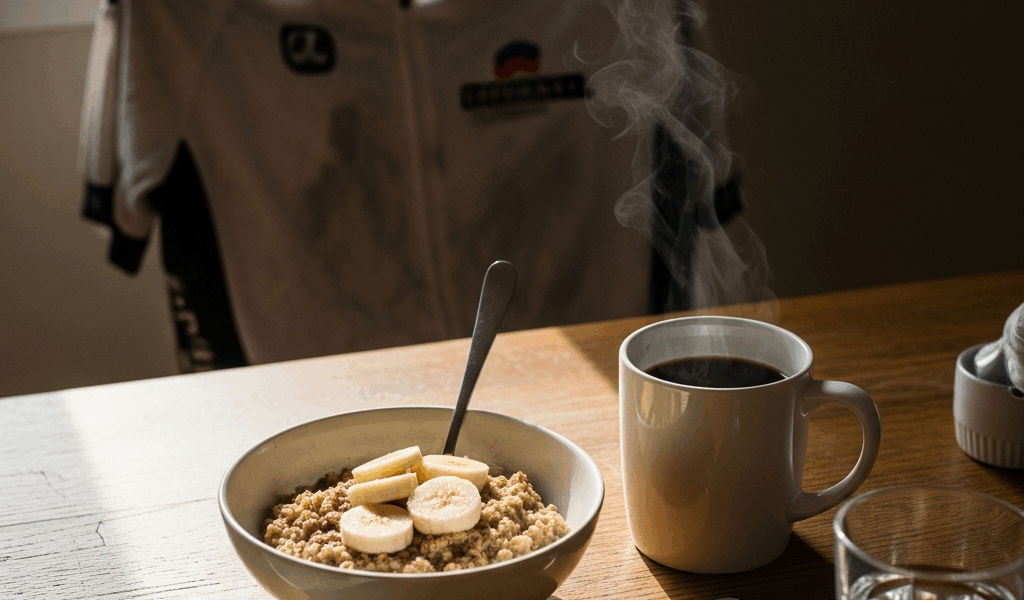
Oatmeal with banana and honey — roughly 70g carbs. Easy to digest, familiar to most stomachs, and the banana adds potassium you’ll need later. Two slices of toast with peanut butter and jam — about 65g carbs. The peanut butter adds protein and fat for slower energy release. A bagel with cream cheese — 55-65g carbs depending on size. Reliable, portable, and most cyclists can eat this without any GI issues.
60-90 minutes before (30-40g carbs):
One banana — 27g carbs. The simplest option that consistently works. A single piece of toast with jam — 30g carbs. One energy bar — check the label, but most are 35-45g carbs. A small bowl of rice with salt — 35g carbs. Rice digests faster than bread for most people.
What to avoid: High-fiber foods (bran cereal, beans, raw vegetables) slow digestion and can cause cramping. High-fat meals (bacon, fried eggs, heavy cream sauces) sit in your stomach for hours. Dairy can be hit or miss — if milk or yogurt doesn’t bother you normally, it’s fine before a ride. If you’ve never tested dairy before a long effort, don’t experiment on event day.
The Golden Rule: Nothing New on Ride Day
Test every pre-ride food during training. Your stomach on a century ride at race effort is a completely different organ than your stomach eating breakfast at home. Foods that feel fine at the kitchen table can cause cramping, nausea, or worse at 85% effort two hours later.
During your training weeks, deliberately test different pre-ride meals before your long rides. Find 2-3 options that work consistently and rotate between them. By event day, your pre-ride nutrition should be a solved problem — not an experiment.
Hydration Before the Ride
Drink 16-20 ounces of water in the 2-3 hours before the ride — sipped gradually, not chugged. If your ride is over 2 hours, add an electrolyte tablet or a pinch of salt to your water. Starting the ride even slightly dehydrated creates a deficit that’s difficult to close while pedaling.
Your urine color before riding is the simplest hydration check. Pale yellow means you’re properly hydrated. Clear means you’ve overhydrated and may need electrolytes. Dark yellow means drink more water before clipping in.
Caffeine: Timing and Amount
Caffeine improves endurance performance — this is well-established in research. The optimal dose is 3-6 mg per kilogram of body weight, consumed 30-60 minutes before the effort. For a 150-pound (68 kg) cyclist, that’s 200-400 mg — roughly 1.5 to 3 cups of drip coffee.
If you drink coffee daily, your tolerance is already built in and you need the higher end of that range. If you rarely drink caffeine, start with 100-150 mg to see how your stomach responds during effort. Caffeine on an empty stomach during hard exercise causes nausea for some riders — pair it with your pre-ride meal to buffer the effect.
Pre-ride nutrition isn’t complicated once you find what works for your body. Two to three hours out, 60-90 grams of carbs, tested during training. That’s it. The riders who bonk at mile 40 aren’t lacking some secret superfood — they either didn’t eat enough, ate too late, or tried something new on event day.

Subscribe for Updates
Get the latest cycling nutrition hub updates delivered to your inbox.
We respect your privacy. Unsubscribe anytime.